The Idea Behind HUMAN PROGRESS (HIPP27 Call)
The HIPP27 HUMAN PROGRESS Call explores how insights from the humanities and social sciences can contribute to research in the natural sciences and help address complex environmental challenges.
The HIPP27 HUMAN PROGRESS Call explores how insights from the humanities and social sciences can contribute to research in the natural sciences and help address complex environmental challenges.
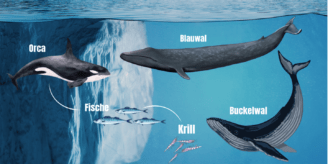
Two detailed presentations (held in German), developed by two young scientists, enable teachers to find an exciting introduction to the topic of marine biodiversity with their pupils. Specifically, they deal with whale research, the food web in the Antarctic and the special ability of whales to hear and utilise sound waves.
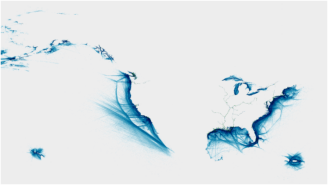
The ocean is most often seen as an empty space, for example in maps, where it is most often depicted as a blue shaded area next to colorful lands, mountains and valleys, forests and deserts, towns and roads. This is due to the traditional approach to creating maps and thinking about landscape (the clue is already in the term), people going as far as they can and writing about the things they find. The ocean in contrast is an inhospitable place to wander for humans, only with the aid of devices such as boats it becomes possible to leave the shore, creating the image of a vast desert in our minds.
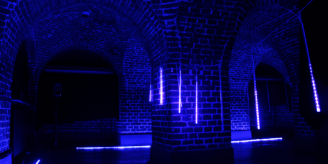
Mirrors is a sound installation that follows the acoustic journey of the Minke Whale as it travels from Antarctica to Namibia. A collaboration between artist-researcher Geraint Rhys and Marine Acoustic scientist Dr Ilse van Opzeeland it charts how the vocalizations of the Minke changes with a change in location as it migrates across the oceans.
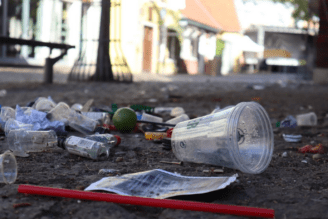
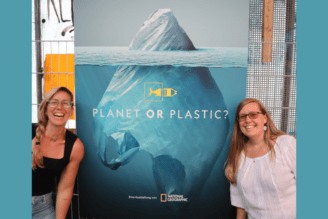
This blog post is part of the ‘Plastic or Planet?’ blog series where we discuss the National Geographic exhibition ‘Planet or Plastic?’ hosted in Oldenburg during the summer of 2022. We are part of an interdisciplinary group of early career researchers working at the Helmholtz Institute for Functional Marine Biodiversity (HIFMB). Here, we focus on ...
Deep-sea mining is a potential new industry in which non-renewable resources could be extracted from the bottom of the deep sea. However, as little is known about the ecosystems of these depths and the impacts of this industry, the prospect of mining these resources poses a great risk.
Art-science collaborations and the ‘Ocean Decade’ - The United Nations (UN) Ocean Decade (2021-2030) is well under way. One of the primary aims in what the UN is calling a 'revolution', is to create an "inspiring and engaging ocean" where society understands and values the benefits of protecting the seas. However, asserting such universalising narratives are complex and never apolitical as there are many layers of communities who are often excluded from society.
This year has marked an exciting time for the Marine Governance Group at HIFMB, one of the core groups of the institute, feeding one of the key pillars of research: conservation and management. New staff at PhD and Postdoctoral level have arrived and Masters students have begun to undertake original research projects. Together they (we!) have been quickly shaping the group, raising critical questions about governing ocean spaces.
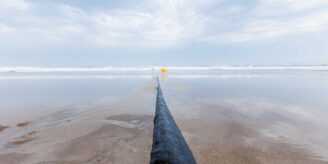
Lately, people worldwide have been caught off guard from hearing the news about the volcanic seamount eruption in the Tongan sea. This eruption caused tsunami waves—sweeping the Pacific Islands, including Tonga Island. This pacific island nation also suffers from fiber optic cable malfunctions laying on the seafloor, often undisturbed by human activities.
Tension. What springs to mind when you think of tension? Images of frustration and anxiety might arise; situations you may not want to revisit, interactions you’d rather forget. As someone who suffers from anxiety and PTSD on a daily basis, it seems counterintuitive for me to argue that tension can be good. But I think it can be.